


WITH OUR PROCESSING VIDEO, YOU GET FURTHER!
PROCESSING AND MAINTENANCE OF CONCRETE
Once you have chosen the right product, it must be installed carefully and neatly to achieve a durable and beautiful paving surface. To simplify this, we have made installation instructions available as video and text. Please take the following installation instructions into account.
PROCESSING PRODUCTS

REDSUN GROUT MORTAR
Learn more 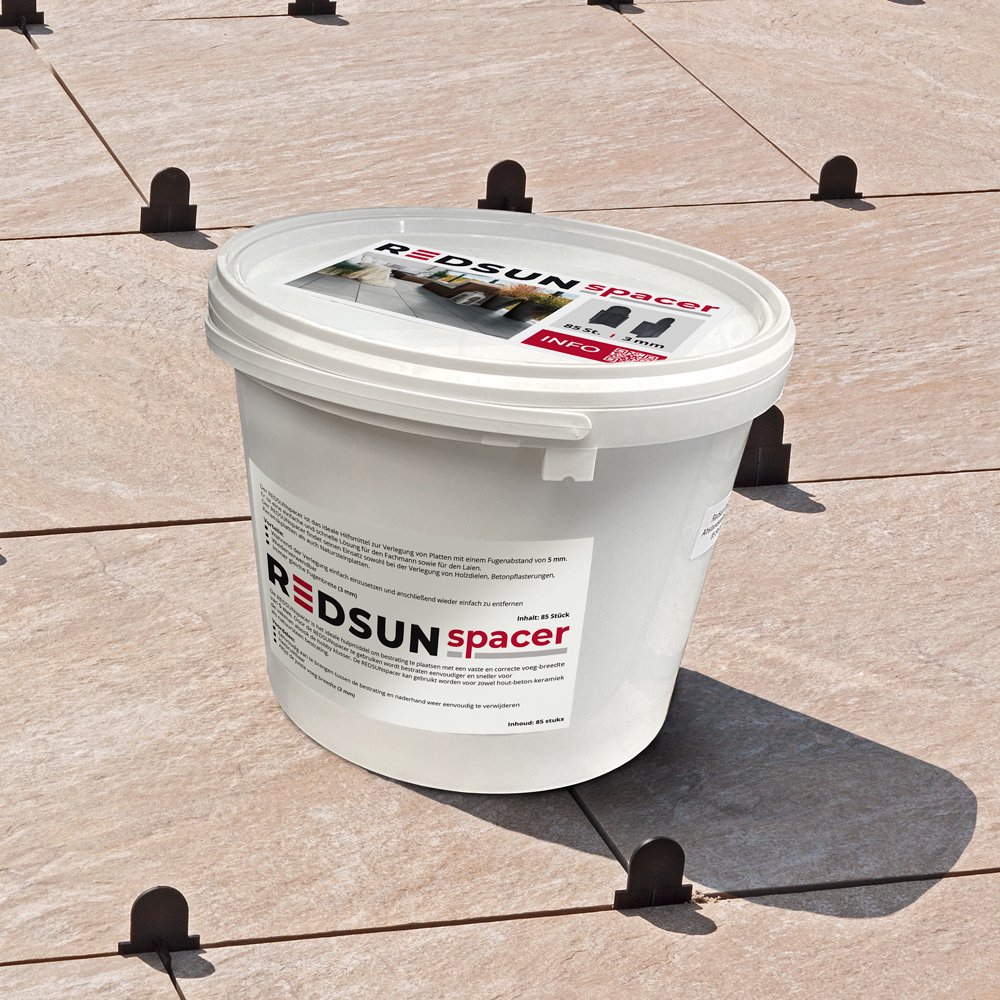
REDSUN SPACERS
Learn more 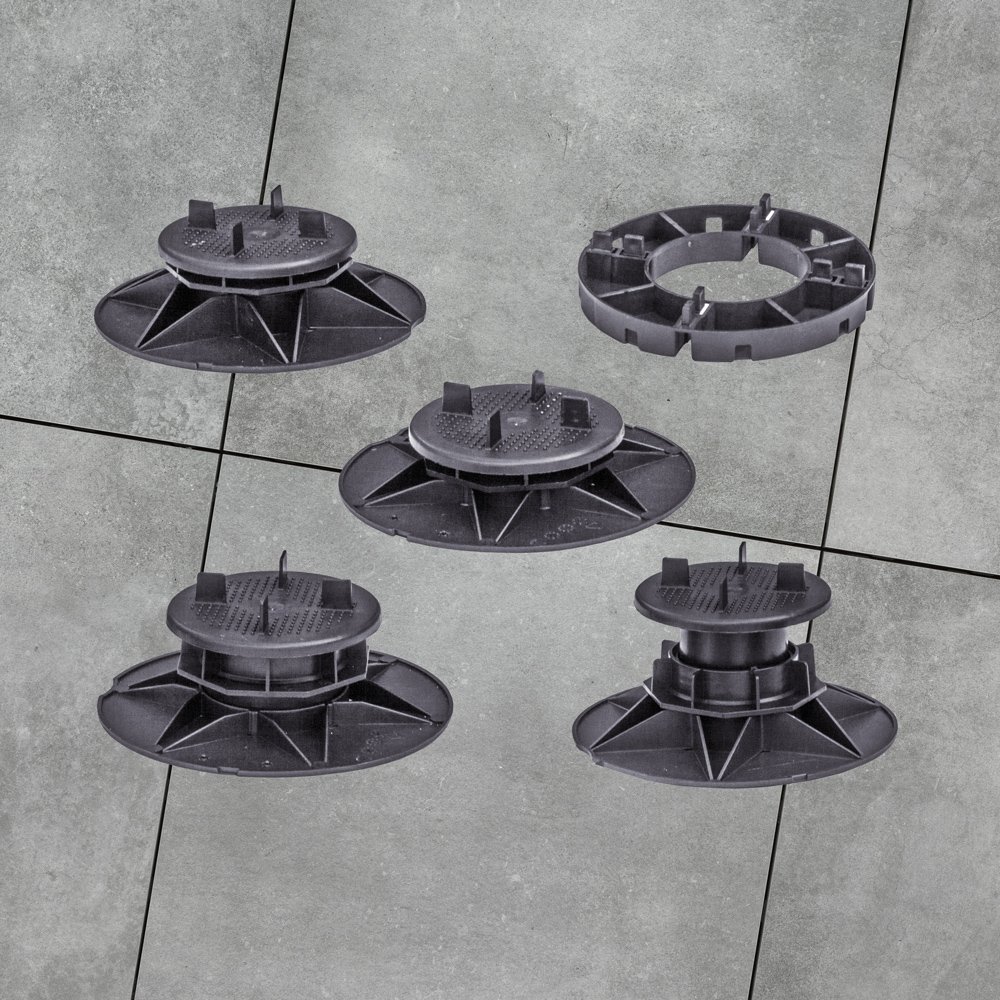
TILE SUPPORTS
Learn more 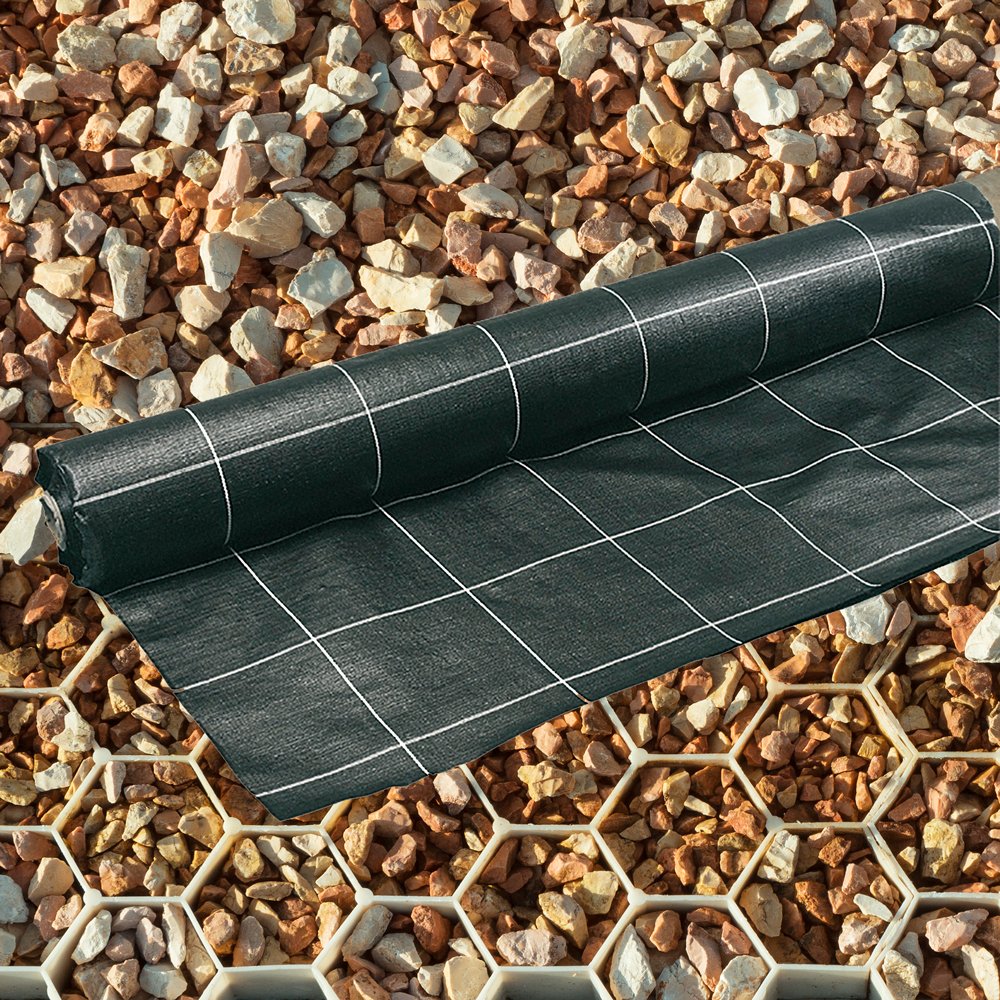
GRAVEL & SPLIT SUPPLIES
Learn more INSTALLATION OF PAVING AND TILES IN STEPS
CONCRETE TILES
- BEFORE LAYING
Before laying the paving, check the material for type, quantity, and quality. If there are any defects, report them in writing before you begin laying.
- PREPARATION OF THE SUBSTRATE
Excavate non-load-bearing soil layers until you reach a stable subsoil. The subsoil must be at least 35 cm below the paving and have a slope of at least 1.5% for proper drainage. Compact the subsoil with a suitable vibratory plate compactor before applying the load-bearing and frost-protective layer.
- LOAD-BEARING AND FROST-PROTECTING LAYER
Apply a load-bearing and frost-protective layer and compact it in layers with gravel or chippings. Ensure there is also a slope of at least 1.5%. Install edge restraints (e.g., edging stones) at the correct height and on a concrete foundation to prevent the stones from shifting. Try to work as much as possible according to the grid size (stone size + joints) to avoid cutting.
- THE BEDING
The bedding consists of a 4-5 cm thick layer of an uncompacted mixture of gravel or sand. Apply it approximately 1 cm higher, as it will settle after compaction. Use tools such as a screed and two leveling boards to finish the bed level with a slope.
- PROCESSING
Once the bed has been laid, do not walk on it. Lay the tiles onto the paved surface from the top down, working row by row. Mix tiles from different packages and layers for a homogeneous color distribution. Ensure the tiles are fully supported to prevent them from tilting later. Use a rubber mallet and a piece of wood to bring the tiles into position. The tiles must not be vibrated! Maintain a joint width of approximately 4 mm to 2 mm (the spacers on the tiles are only for protection during transport). Use REDSUN Spacers for an even joint appearance. Use a guideline to ensure everything is laid straight. Continuously adjust the surface as you progress and avoid walking on or driving over the unlaid sections.
- GROUTS
Completely fill the joints, with a width of approximately 4 mm to 2 mm, with suitable jointing material (e.g. jointing sand with a grain size of 0.02-2 mm).
Continue adding jointing material as you progress. Ensure that the surface is clean and free of residue after completing the jointing. You can also use a one- or multi-component jointing mortar, but carefully follow the manufacturer’s instructions.
CONCRETE PAVING
- BEFORE LAYING
Before laying the paving, check the material for type, batch, quantity, and quality. If there are any defects, report them in writing before you start laying.
- PREPARING OF THE SUBSTRATE
Excavate non-load-bearing soil layers until you reach a stable subsoil. The subsoil must be at least 35 cm below the paving and have a slope of at least 1.5% for proper drainage. Compact the subsoil with a suitable vibratory plate before applying the load-bearing and frost-protective layer.
- LOAD-BEARING AND FROST-PROTECTION LAYER
Apply a load-bearing and frost-protective layer and compact it in layers with gravel or chippings. Ensure there is also a slope of at least 1.5%. Place edging (e.g., curb stones) at the correct height and on a concrete foundation to prevent the stones from shifting. Try to work as much as possible according to the grid size (brick size + joints) to avoid cutting.
- THE BEDDING
- LAYING
- JOINTING
- VIBRATING THE PAVING
The bedding consists of a 4-5 cm thick layer of an uncompacted mixture of gravel or sand. Apply it approximately 1 cm higher, as it will settle after compaction. Use tools such as a screed and two leveling boards to finish the bed level with a slope.
Once the bed has been laid, do not walk on it. Lay the paving stones on the paved surface from the top down and work row by row. To achieve an even color distribution, mix stones from different packages and layers. Maintain a joint width of approximately 4 mm. Use a guideline to ensure everything is laid straight. Continuously lay the surface as you progress, and avoid walking on or driving over the parts that have not yet been laid.
Fill the joints, approximately 4 mm wide, completely with suitable jointing material (e.g. jointing sand). Continue adding jointing material as you progress. Ensure the paving surface is clean and free of residue after completing the jointing. For water-permeable paving stones, use jointing split with a grain size of 1-3 mm (available in 3 colors).
Ensure the surface is dry and clean before you start vibrating, as residue can damage the paving stones. Use a suitable vibrating plate
with a rubber mat for vibrating. After vibrating, refill the joints and wipe the surface clean. See page 21 for advice regarding the use of a vibrating plate.
CLEANING & MAINTENANCE
Although paving and tiles are a simple way to lay patios, garden paths, or driveways, they have to endure a lot. Over time, weeds grow between the stones, green deposits form, and leaves accumulate on the stones. However, there are ways to ensure that your surface looks well-maintained.
As a first step, regularly sweep the surface clean to remove coarse contaminants. If this is not sufficient, proceed to the second step and use household remedies (e.g., a soda-water mixture) or special cleaning agents (for removing green deposits, etc.). The use of a high-pressure cleaner is discouraged, as the high pressure can cause the stones to become rougher and accumulate more dirt. In the case of impregnated stones, the protective impregnation may be damaged. Seek advice from a trusted professional regarding this.
Joints can be cleaned with a joint brush, a weed scraper, or a weed burner. The use of weed killers is discouraged, as they are often prohibited for environmental reasons.
LIME EFFLORESCENCE
It is important to know that concrete mainly consists of the components sand, gravel, water, and cement, where the cement, in turn, is made from clay and limestone. Efflorescence on concrete pavers is caused by natural ingredients and is a phenomenon in which white spots appear on the surface of the stone. These spots can vary in size and shape. Water, such as rain, condensation, or dew, penetrates the pores of the concrete into the stone and partially dissolves the lime there. The solution penetrates to the surface, the water evaporates, and a white lime deposit remains.
Efflorescence does not constitute a structural problem and does not affect the strength or durability of the concrete paver. In some cases, efflorescence can be removed by cleaning. For this, you can use special cleaners that are solvent-free and biodegradable, but in many cases, efflorescence disappears naturally over time due to weathering and use of the surface.
You can prevent the problem by ensuring that rainwater can drain quickly from the paving surface during installation by providing adequate drainage. Furthermore, concrete products must be processed in a timely manner after purchase.